
Heartsaver CPR Class September 2016
Heartsaver CPR AED Class, Friday Evening September 30th, 2016
I'll be offering an American Heart Association Heartsaver Adult CPR/AED Class on Friday evening, September 30th from 7 to about 9 pm (could run a bit longer depending on class size) at the Drakes Crossing Fire Station at 19364 Powers Creek Loop RD NE Silverton, OR 97381.
I'll be offering an American Heart Association Heartsaver Adult CPR/AED Class on Friday evening, September 30th from 7 to about 9 pm (could run a bit longer depending on class size) at the Drakes Crossing Fire Station at 19364 Powers Creek Loop RD NE Silverton, OR 97381.
COURSE CONTENT
Send Mike Niemeyer an email to reserve your spot and bring a check for $25 to the class, made out to "Drakes Crossing RFPD." (If this class fills priority will be given to participants in the Wilderness first Aid class the following weekend.)
- Adult CPR and AED use
- Key changes reflecting the new science from the 2015 American Heart Association Guidelines for Cardiopulmonary Resuscitation and Emergency Cardiovascular Care
- Optional modules in child CPR (for those who would like to stay after to complete that module.
- Successful participants will receive an AHA CPR/AED card good for 2 years.
- Leif Wisdahl
- James Green
- Keith Garlinghouse
- Croghan, Lyndsay
- Bittel, Emily
- Bittel, Jason
- Robert, Joanna
- Chonteh Rivertree
Waitlist
- Justin Clark
TO PREPARE FOR CLASS
- Course text book Heartsaver CPR. I'll have copies available for review in class for you to look at but recommend you purchase and read the text prior to class.
- Please wear loose, comfortable clothing to class. You will be practicing skills that require kneeling, bending, standing, and lifting.
- If you have any physical conditions that might prevent these activities, please tell one of the instructors. The instructor may be able to adjust the equipment to accommodate you. Also please tell your instructor if you are allergic to latex.
- Heartsaver CPR skills sheet (2015 version) - this is the sheet that you will be tested on.
- Heartsaver 2015 CPR changes (2 page FAQs)
- 2015 CPR and First Aid Changes - Highlights (32 page pdf)
- Free First Aid APP - The American Red Cross has a helpful first aid app for your smartphone,


Silver Falls Trail Maintenance, March 19th 2016
Thank you to our mighty Chemeketan Trail Crew - The Perimeter Trail is now clear of trees! (Pictures below) Crew: Matt Rieke; Katie Woodward; Mike Niemeyer; Aaron Reyna; Mark Olsen; Kenneth Jones; Gayle Geraths; Don Geraths; Chuck Bennett; Brett Milliken; and Andree Bain - and Ranger Steve Hernandez.


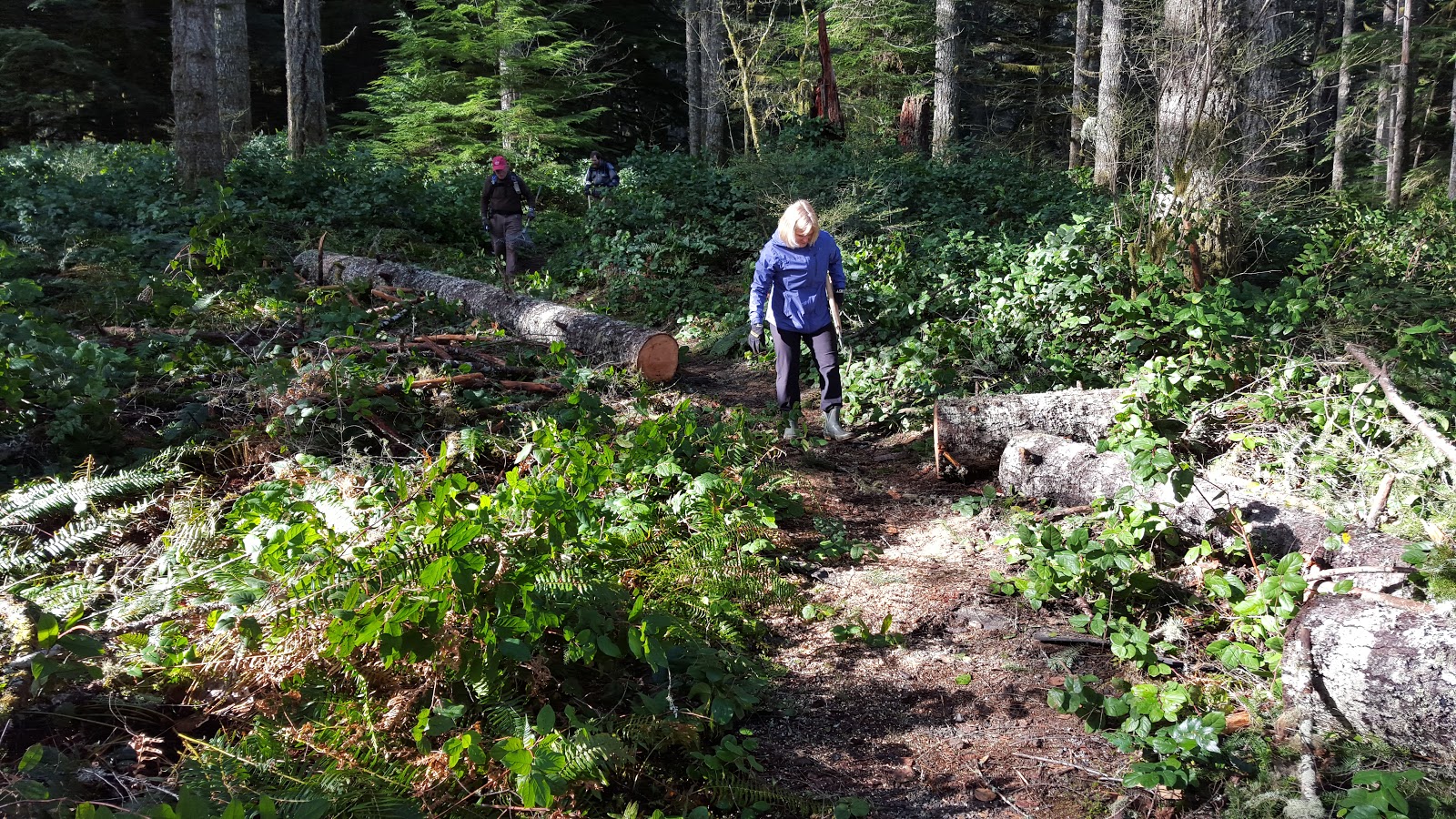

As part of the Chemeketans sponsorship of Silver Falls State Park we provide trail maintenance at the park a couple times a year. This is an event open to everyone who is interested in supporting Silver Falls Sate Park.
For the project on March 19th we will meet at the park office at 9 am and take 4wd vehicles up the Y camp fire road to a staging area at the Buck Mountain loop/ Perimeter trail. See map below. The Red line is the route we have taken before, the yellow are possible exit routes if no ones wants to take the same way back, and the blue route is an alternative vehicle accessible route (4x4 only). We could even split the group in half and start on different sides.
Ranger Steve will stage a Gator (ATV) to help shuttle people and supplies to the work area. Project will consist of a clearing blowdown from this winter. Trip goes rain or shine. Park will supply all needed tools but you will need water, food, gloves, sturdy footwear and appropriate clothing for the weather. (Ranger Steve said he ran into some patches of snow on Wednesday.) We will be done by 1 PM.

Email Mike Niemeyer to register and let me know if you are interested in carpooling from Salem and I'll connect you with others who want top carpool.

Intermediate Snow Skills, May 7th 2016
 On Saturday May 7th, 2016 I'll be leading a Chemeketan intermediate snow skills class. We will carpool up to Mt Hood on Saturday morning, arriving at Timberline Lodge parking area (same place as for climb school) between 8 and 8:30 AM. (Note: No snow park permit needed.) After gearing up and hiking to the training area we will practice intermediate snow skills including:
- intro to avalanche assessment/snow pit tests,
- belaying, and escaping belays, off a snow anchor
- z-pulley rescues and
- (for the newer climbers) some exposure to crampon use.
To register email Mike Niemeyer at mikessummits@gmail.com with your contact information and a brief explanation of your climbing experience (If you just finished climb school and have no other experience that's fine - just let me know so we can plan accordingly.)

- Mike Niemeyer (Leader)
- Milan Apeltauer
- Bauer, Kelly
- Benitez, Fernando (Helper)
- Blanton, Craig (Helper)
- Elston, Kevin
- Folin, Steve
- Fredrickson, Justin
- Gill, Forrest (Helper)
- Hart, Gary
- Ibele, Austin
- Lande, Peter
- Salaz, Chris (Provisional leader)
- Starr, Bryan
- Wolfgang, Jared
- Surely (Ken) Jones (Helper)
- Tyler Plagmann
- Sue Nelson (Helper)
- Kelley Simons
- Gordon Kenyon
- Jay Howe (Helper)
- Josef Larsen
- Jason Bittel
- Emily Bittel
- Christopher W. Leesman
- Leif Wisdahl
- Aaron Lopez
- For the recent climb school students with little snow experience this will be an opportunity to practice being an effective member of a roped team on snow/glacier. This includes: being able to efficiently tie into the rope system, move confidently on steep snow using crampons and ice axe, clip efficiently through snow anchors and self-rescue after a fall into a crevasse.
- For the more experienced climbers and assistants this is an opportunity to set up and lead a rope team, belay off of an anchor to bring the team up to your location on steep terrain, and set up and execute a rescue using a z pulley system (for this later skill we will be looking at managing the rescue scene and teamwork - not just the mechanics of building a z-pulley).
 |
| Snow pit compression tests |
Equipment:
We will be getting into steep snow conditions for this outing. Ice axe, harness, helmet and crampons (fitted to your boots ahead of time) are required. Crampon compatible boots and gators. Sunglasses are also required. I recommend that you pack as you would for a Mt Hood Climb. this will be a good chance to test your gear and food/water options out. Prussik cords are required. Pulleys, a couple extra carabiners and shovels will be helpful if you have them. I'd like to have one shovel per rope team.
Please have your gear together and be prepared to carry some group gear (ropes, shovels, etc.) Its best to have a larger pack and have some external straps for lashing down a rope and strapping on an ice axe (i.e., don't come with a small textbook type daypack. I've got nothing against Care Bears but their equipment line rarely includes ice axe loops.)
We will be getting into the snow so a waterproof outer shell layer is important and an extra set of gloves to swap out when your first pair gets wet. See Gear List #4. Bring plenty of water (at least 2 liters) and food as we won't be returning to the cars during the day. Leader will be carrying, hypowrap materials, first aid kit and cell phone 503-910-9726. If you have a Motorola type recreationall radio please bring it set to Channel 10 code 5.
Location
We will head NE out of the Timberline parking lot and about 1000 ft vertical to seek some suitable steep terrain on the edge of the white river canyon.
Please have your gear together and be prepared to carry some group gear (ropes, shovels, etc.) Its best to have a larger pack and have some external straps for lashing down a rope and strapping on an ice axe (i.e., don't come with a small textbook type daypack. I've got nothing against Care Bears but their equipment line rarely includes ice axe loops.)
We will be getting into the snow so a waterproof outer shell layer is important and an extra set of gloves to swap out when your first pair gets wet. See Gear List #4. Bring plenty of water (at least 2 liters) and food as we won't be returning to the cars during the day. Leader will be carrying, hypowrap materials, first aid kit and cell phone 503-910-9726. If you have a Motorola type recreationall radio please bring it set to Channel 10 code 5.
Location
We will head NE out of the Timberline parking lot and about 1000 ft vertical to seek some suitable steep terrain on the edge of the white river canyon.
For carpooling Saturday morning those leaving from the Salem Motor pool lot should plan on leaving at 6:00 am. I'll send a group email out to give you a chance to connect with others for a ride. Please don't plan on showing up at the park-and-ride lot without pre-arranging a ride - there may not be anyone there! State Motor Pool in Salem - This will be the best option for folks in Salem or points south. Let me know if you are interested in this option.
Training Curriculum:1) Planning Meeting- For those of you attending the Chemeketan Climb School April 1st I'll be available after our closing ceremony at Timberline lodge to answer any questions you might have about gear or preparation for the intermediate snow class. If that doesn't work for you feel free to email or call me with any questions.
2) Group assembles at the end of the "climbers" parking lot: Assign teams; Issue group gear: Pickets (1 per person) shovels (1 per team), ropes (1 x 50 meter half-rope per team). Leaders check teams gear (e.g., no sharp things swinging off of the packs, everyone has sunglasses, has put on sunblock, etc) FRS radios to Channel 10 Code 5.
2) Once in our practice area we will do snow pit tests to access avalanche conditions and discuss snow cave construction. I have a snow saw and various snow assessment tools. We will be doing the compression test after digging out and isolating a snow column and also assessing the hardness of the snow layers.

3) Establishing and moving rope teams rigged for Glacier travel. The goal of this exercise is for the recent climb school students to practice being an effective member of a roped team on snow/glacier. This includes: being able to efficiently tie into the rope system and move confidently on steep snow. (For the more experienced climbers and assistants this is an opportunity to set up and lead a rope team.) The rope team leader will take their team to an area suitable for crevasse rescue practice. (Coaching on good rope management , improving steps, etc.)
4) Crevasse rescue scenario: The goal of this exercise is for the recent climb school students be able to self-rescue after a fall into a crevasse using prussiks and gain familiarity with the Z-pulley system. For the more experienced climbers and assistants set up and execute a rescue using a z pulley system (for this later skill we will be looking at managing the rescue scene and teamwork - not just the mechanics of building a z-pulley). SCENARIO: Rope team members 1 and 2 arrest fall of member #3 and set up z Pulley. Member #3 initiates self-rescue. This will be a full scenario beginning with the fall and team arrest. (i.e. not just the mechanical aspects of rigging the system)
5) Belaying on steep snow: The goal of this exercise is For the recent climb school students be able to belay the leader on steep snow. For the more experienced climbers and assistants this is a chance to practice establishing and belaying off of anchors on steep snow and, as time allows, escaping the belay using a Munter-Mule.
AHA First Aid Class, February 5th, 2016 - Cancelled
AHA First Aid Class, February 5th, 2016 - Class Cancelled
Heartsaver® First Aid is a classroom, video-based, instructor-led course that teaches students critical skills to respond to and manage an emergency in the first few minutes until emergency medical services (EMS) arrives. Students learn skills such as how to treat bleeding, sprains, broken bones, shock and other first aid emergencies. This course is for anyone with limited or no medical training who needs a course completion card in first aid to meet job, regulatory or other requirements. Upon completion of this course, students receive an American Heart Association Heartsaver First Aid Course Completion Card that is valid for two years. (Note that this is not a Wilderness First Aid Class and does not cover CPR. See the main menu for those offerings.)
Instructor is Mike Niemeyer. Bio.
Location: Drakes Crossing Fire Station at 19364 Powers Creek Loop RD NE Silverton, OR 97381.
Cost: $25
Class begins at 6 PM. This course will run 3.5 to 4 hrs depending on experience level of the class.
To Register: Send Mike Niemeyer an email to reserve your spot and bring a check for $20 to the class, made out to "Drakes Crossing RFPD."
ROSTER
Heartsaver® First Aid is a classroom, video-based, instructor-led course that teaches students critical skills to respond to and manage an emergency in the first few minutes until emergency medical services (EMS) arrives. Students learn skills such as how to treat bleeding, sprains, broken bones, shock and other first aid emergencies. This course is for anyone with limited or no medical training who needs a course completion card in first aid to meet job, regulatory or other requirements. Upon completion of this course, students receive an American Heart Association Heartsaver First Aid Course Completion Card that is valid for two years. (Note that this is not a Wilderness First Aid Class and does not cover CPR. See the main menu for those offerings.)
Instructor is Mike Niemeyer. Bio.
Location: Drakes Crossing Fire Station at 19364 Powers Creek Loop RD NE Silverton, OR 97381.
Cost: $25
Class begins at 6 PM. This course will run 3.5 to 4 hrs depending on experience level of the class.
To Register: Send Mike Niemeyer an email to reserve your spot and bring a check for $20 to the class, made out to "Drakes Crossing RFPD."
ROSTER
- Mike Niemeyer (instructor)
- Steve Dougherty
- Chris Salaz
- It is recommended that you read the Heartsaver First Aid handbook listed below. (Copies of these materials will also be available in class for review.)
- Please wear loose, comfortable clothing to class. You will be practicing skills that require kneeling, bending, standing, and lifting.
- If you have any physical conditions that might prevent these activities, please tell one of the instructors. The instructor may be able to adjust the equipment to accommodate you. Also please tell your instructor if you are allergic to latex.
- Heartsaver First Aid and CPR Student Workbook is Available on Amazon as a used book for about $4.00) This workbook is good for both the Heartsaver CPR class and the Heartsaver First Aid class. This document has the 2010 protocols. The 2015 protocols are not yet available in a handbook but you can download an update at 2015 Student Workbook First aid updates .
- Free First Aid APP - The American Red Cross has a helpful first aid app for your smartphone, see http://www.redcross.org/mobile-apps/first-aid-app.
Chemeketan Climb School April 2016
The Chemeketan Climb School 2016 Schedule is:
Classroom sessions (evenings) Wednesday April 20 and 27 with locations to be announced.
Field sessions will be April 30 at Horsethief Butte (Rock Day) and May 1 at Mt Hood (Snow Day).
Theresa Conley is the coordinator for climb school. Mike Rudy is the coordinator for Anchor building class on Friday April 29 at Horsethief Butte. For additional information see http://www.chemeketans.org/climbing.asp


Classroom sessions (evenings) Wednesday April 20 and 27 with locations to be announced.
Field sessions will be April 30 at Horsethief Butte (Rock Day) and May 1 at Mt Hood (Snow Day).
Theresa Conley is the coordinator for climb school. Mike Rudy is the coordinator for Anchor building class on Friday April 29 at Horsethief Butte.
 For additional information see http://www.chemeketans.org/climbing.asp

Heartsaver CPR AED Class January 29, 2016
CPR instructors Mike Niemeyer (AEMT) and Ethan Hupp (Paramedic) will be offering an American Heart Association Heartsaver Adult CPR/AED Class on Friday evening, January 29th from 7 to about 9 pm (could run a bit longer depending on class size and experience level) at the Drakes Crossing Fire Station at 19364 Powers Creek Loop RD NE Silverton, OR 97381.
COURSE CONTENT
TO REGISTER
COURSE CONTENT
- Adult CPR and AED use
- We will be using the current 2010 American Heart Association Guidelines for Cardiopulmonary Resuscitation and Emergency Cardiovascular Care
- Optional modules in child CPR and AED (for those who would like to stay after to complete that module. about 45 minutes additional - no extra charge.)
- Successful participants will receive an AHA CPR/AED card good for 2 years.
Carpool
We have a few folks leaving from the State Motorpool lot at 5:45 pm to carpool from Salem. Email Mike Niemeyer for details if you want to share a ride.
Send Mike Niemeyer an email to reserve your spot and bring a check for $20 to the class, made out to "Drakes Crossing RFPD."
ROSTER
Mike Niemeyer (Instructor)
Ethan Hupp (Instructor)
- Kenneth Jones
- Chris Salaz
- Aislinn Adams
- Craig Blanton
- Sarah Blanton
- William Davis
- Vince Dunn
- Cathy Lazarus
- Gabriel Starr
- Dalia Andrade
- Forrest gill
TO PREPARE FOR CLASS
- Heartsaver First Aid andCPR Student Workbook is Available on Amazon as a used book for about $4.00) This workbook is good for both the Heartsaver CPR class and the Heartsaver First Aid class. I'll have copies available for review in class but recommend you purchase and read the text prior to class. Note that this document has the 2010 protocols. The 2015 protocols are not yet available in a handbook but you can download an update at 2015 Student Workbook CPR updates.
- Please wear loose, comfortable clothing to class. You will be practicing skills that require kneeling, bending, standing, and lifting.
- If you have any physical conditions that might prevent these activities, please tell one of the instructors. The instructor may be able to adjust the equipment to accommodate you. Also please tell your instructor if you are allergic to latex.
- 2015 Guidelines - Highlights (This is not a required read but if you are looking for the details behind the changes in CPR science its a good place to start.)
- Free First Aid APP - The American Red Cross has a helpful first aid app for your smartphone, see http://www.redcross.org/mobile-apps/first-aid-app.
Team 18 WFA (May 30-31, 2015)
Wilderness First Aid Course Description - The course will cover first aid skills and decision-making using realistic emergency medical scenarios as might be encountered on a climbing, hiking or backpacking trip in the Cascades. This will be a fun, intense, hands-on course using outdoor scenarios in dark, cold, wet conditions. This interactive, outdoor class is the place to "Take chances, make mistakes and get messy"(Ms. Frizzle) so you can be prepared and confident in aiding injured people you might encounter in remote settings. Participants will receive a wilderness first aid course completion certificate upon successful course completion.
Venue - Camp Tolaoli
Schedule - We begin promptly at 8 AM on Saturday and have an evening scenario after the dinner break Saturday. Sunday we go from 8 am to 5 pm.
Trainers
- Mike Niemeyer, AEMT (Wilderness), Wilderness Medical Instructor (Bio at http://mikessummits.blogspot.com/search/label/climb%20resume)
- Jackie Niemeyer, RN, Wilderness Medical Instructor
Student Prerequisites and Preparation
- Must have the ability to lift 40 lbs to participate fully in scenarios (persons with back or other medical issues have the option to sit out patient transportation exercises)
- Current CPR certification recommended.
- Students must read and sign a class agreement and release form at the first class or during the registration process.
- Students will need a watch that displays seconds and a headlamp.
- Bring a day pack or backpack that can get knocked around a bit – with supplies you’d typically bring on an outing.
- Bring an extra thrift-store quality shirt and pants/sweat pants – should you volunteer to be a patient in a scenario. A small foam pad is optional - something for you to sit or kneel on when you are outside assisting a patient.
- Wear/bring warm clothes and a waterproof shell layer or rain pants/coat appropriate for the weather for this weekend.
- Bring a towel or rags to dry off as we come in from outside scenarios.

 Course reading: Students receive a copy of the course text as part of the course fee (Text will be provided to you - don't purchase this on your own.) This is a highly interactive course that will have students diving into things right away. To get the most out of it students will need to have read the course text (AAOS Wilderness First Aid, 4th edition) prior to the first day of class.
Course Outline and Chapter Reading Assignments:
|
#
|
Module
|
Details
|
|
1
|
Intro
|
Welcome and Introductions, General
Scenario instructions, quiz
|
|
Introduction to Wilderness First
Aid (Chapter 1):
• What Is Wilderness? • What Is Wilderness First Aid? • Legal and Ethical Issues • Psychological and Emotional Issues • Infectious Disease Precautions |
||
|
2
|
Action
in an emergency
|
Action at an Emergency (Chapter
2):
• Mechanisms of Injury • Moving a Victim • Extrication From Difficult Locations • Seeking Help • Guidelines for Evacuation |
|
|
break
|
|
|
3
|
Assessment
|
Victim Assessment and Urgent Care
(Chapter 3):
• Assessment • Scene Survey • Initial Assessment • Victim’s History • Vital Signs and Physical Exam • Ongoing Assessment |
|
|
Lunch
Break
|
|
|
4
|
Bleeding
& wounds
|
Care of Bleeding, Wounds, and
Burns (Chapter 4):
• Bleeding • Wounds • Burns |
|
|
Break
|
|
|
5
|
Dressings
& Bandages
|
Dressings and Bandages (Chapter 5):
• Dressings • Bandages • Applying and Removing a Dressing • Bandaging Techniques |
|
|
Break
|
|
|
7
|
Bone
& Joint
|
Bone, Joint, and Muscle Injuries
(Chapter 7):
• Bone Injuries |
|
7
|
Bone
& Joint
|
Bone, Joint, and Muscle Injuries
(Chapter 7):
• joint Injuries & Scenario |
|
|
|
SUNDAY (Day 2)
|
|
|
Intro/review
|
Review/Introduce
todays activities
|
|
7
|
Muscle
Injuries
|
Bone, Joint, and Muscle Injuries
(Chapter 7):
• Muscle Injuries |
|
|
Break
|
|
|
15
|
Environmental
Illness Part 1
|
Physical and Environmental Hazards
(Chapter 15):
• Acute Mountain Sickness, HAPE, and HACE • Cold Injury |
|
|
lunch
break
|
|
|
15
|
Environmental
Illness Part 2
|
Physical and Environmental Hazards
(Chapter 15):
• Heat Illness • Lightning Injury |
|
|
Break
|
|
|
16
|
Plants
& Toxins
|
Poisons, Toxins, and Poisonous
Plants (Chapter 16):
• Toxic Plants and Poisons • Plant-Induced Dermatitis |
|
17
|
Animal
Bites
|
Animal Bites, Human Bites, and
Snake Bites (Chapter 17):
• Animal Bites • Snake Bites |
|
18
|
Insect
bites
|
Insect and Arthropod Bites and
Stings (Chapter 18):
• Spider Bites • Scorpion Stings • Tick Bites • Mosquito Bites • Insect Stings • Insect Repellents |
|
|
|
WFA Rodeo
|
|
App
E
|
Rescue
Operations
|
Pt Care Repoting &
Communications
|
|
|
Exam
|
Final Written Exam
|
Questions about this course? info@wildmedical.com
Silver Falls Interpretive Volunteers Needed
.jpg) The Canyon Trail Interpretive Volunteers came into being in order to get more boots on the ground during the season to help visitors who walk the trail. More and more visitors come to the park, almost 1.5 million last year, and due to budget constraints, the park does not have additional rangers or hosts who can commit time to the trail.
The Canyon Trail Interpretive Volunteers came into being in order to get more boots on the ground during the season to help visitors who walk the trail. More and more visitors come to the park, almost 1.5 million last year, and due to budget constraints, the park does not have additional rangers or hosts who can commit time to the trail.
The Canyon Trail Interpretive Volunteers (CTIV) carry a pack that weighs about 15 pounds. It contains reference material to answer flora and fauna questions, and water to give visitors who really need it an
d did not bring any with them. Some first aid supplies to hand out to visitors are also carried. CTIVs do not do any hands on first aid. In an emergency, a ranger is contacted by radio. All CTIV teams carry a park radio and are trained to use it.
For the most part, CTIVs work in pairs. They also must be in physical shape to hike the entire trai
l once a week. It is not always necessary, and the trail can be divided up, but in case of an emergency a CTIV must be able to get from one end of the trail to another.
The days of the week that CTIVs are really needed are Friday, Saturday, Sunday and Monday. During the height of the season, any day would be appreciated! There is flexibility for vacations and schedules can be worked around with advance notice.
Because CTIVs come in contact with children, each person get a criminal background check.
The Canyon Trail Interpretive Volunteers came into being in order to get more boots on the ground during the season.
The ideal is to start the first week in May with training in April. If you are interested in volunteering as a CTIV, contact Mary at 503-551-6578 or 503-835-1508 or e-mail her at maryf.jackson@ymail.com
Also see the Friends of Silver Falls Website for other events and opportunities.
The ideal is to start the first week in May with training in April. If you are interested in volunteering as a CTIV, contact Mary at 503-551-6578 or 503-835-1508 or e-mail her at maryf.jackson@ymail.com
Also see the Friends of Silver Falls Website for other events and opportunities.
Silver Falls Trail Maintenance March 14, 2015
On a rainy Saturday, March 14, 2015 we had 13 brave volunteers participate in a Chemeketan Trail Maintenance project at Silver Falls State park. We met Ranger Steve Hernandez at the Park headquarters building at 9 am and took a bumpy shuttle ride to the work site on the Perimeter Trail.


 According to Ranger Steve our efforts helped "Re-established trail tread (inslope sloughing was very bad) on a very "hairy" portion of the Perimeter Trail. Visitor and staff safety (quad operation) has greatly improved. " This was the leaders 60th birthday, alternative trip title was "Its my party and I'll pry if I want to."
Our mighty team:


Our mighty team:
- Mike Niemeyer
- Jackie Niemeyer
- Alicia Niemeyer
- Matt Niemeyer
- Katie Woodward
- Ryan Woodward
- Tim Novak
- Jim DaRoss
- Jim Todd
- Mark Penewit
- Nate Hartle
- Dorothy Brown-Kwaiser
- Guy Rodrique
- Ranger Steve Hernandez
Subscribe to:
Posts (Atom)


